Why Spreading Out an Expense Doesn't Make It Smaller
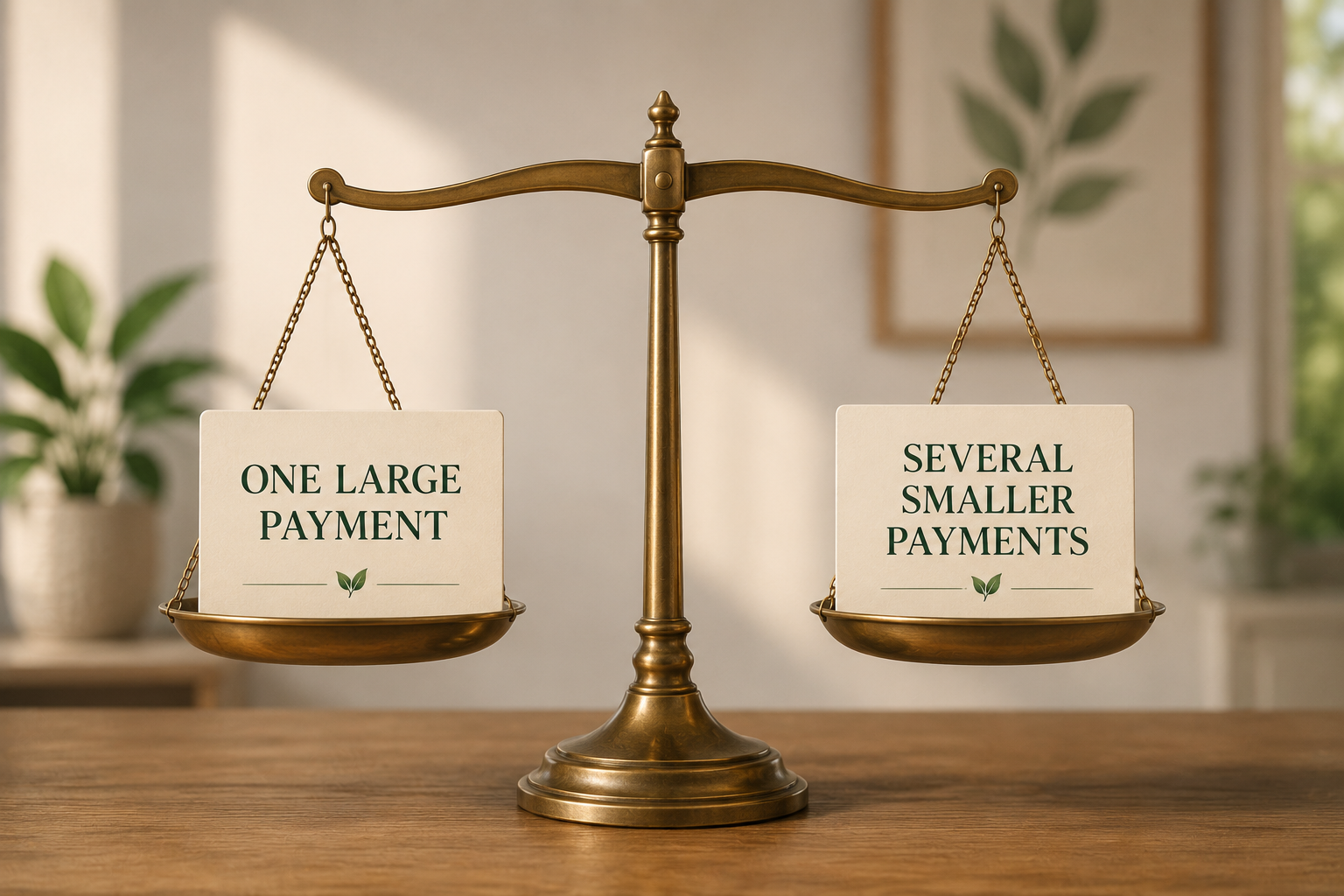
Imagine you've just booked a dream vacation. The trip costs $8,000, and you have the money available to pay for it today.
But making a single $8,000 payment feels painful.
Then you notice other options. Perhaps a 0% credit card offer. Maybe a home equity line of credit. Perhaps another source of low-interest financing.
Suddenly, spreading the cost over many months feels much more manageable.
The interesting question isn't whether the math works. The question is whether spreading out the payments actually changes the expense. In many cases, it doesn't. The total cost may be exactly the same; only the timing changes.
Yet many people experience a large one-time expense very differently than a series of smaller payments. The monthly payment feels easier to absorb, even though the overall spending may be identical.
A similar situation can occur when paying off a car loan.
Imagine two people with a $20,000 balance remaining on a vehicle. One person pays off the loan immediately. The other continues making monthly payments.
From a financial perspective, they may end up in similar positions for quite some time, especially if the interest rate is low. But emotionally, the experience can feel very different.
The person who pays off the loan sees no more car payment leaving their account. Their monthly cash flow immediately improves. The person who continues making payments sees money leaving every month, creating a constant reminder that some of their income has already been committed.
This highlights an interesting aspect of human behavior. Most people pay far more attention to monthly cash flow than to total wealth. A $400 payment demands attention every month, while a $20,000 change in net worth often fades into the background.
Retirement often brings this idea into sharper focus.
During working years, spending is continually replenished by future paychecks. A large purchase may feel less significant because new income is already on its way. In retirement, the direction of cash flow changes. Large withdrawals can feel more uncomfortable because there is no paycheck replacing the money.
As a result, some retirees may prefer spreading expenses over time even when they have the cash available. But sometimes the preference has less to do with financial optimization and more to do with reducing the emotional discomfort of a large withdrawal.
There is nothing inherently wrong with that.
The key is understanding the difference between a financial decision and an emotional reaction to a financial decision.
If the money has already been set aside for a planned expense, changing the payment schedule may not change the true cost. It may simply change how the spending feels. Likewise, eliminating a monthly payment may not make someone wealthier if the freed-up cash is quickly absorbed by other spending.
Understanding these psychological effects can help us make decisions more intentionally and with greater awareness of what is actually driving the choice.
Sometimes the real question is not:
"How can I reduce this expense?"
It's:
"Am I reducing the expense, or am I reducing the feeling of the expense?"
Those are not always the same thing.
Here to make everyday money decisions easier,
Better Money Solutions
